
Hello mommies and daddies out there!
So here you are, talking to your baby or toddler in English all day long, doing your best to help them grow up bilingual in those ordinary, everyday moments. And you’re doing great!
But every now and then, there comes a moment when you wish you had just the right phrase for a certain situation — and you’re not quite sure what it is… or you don’t even realize there’s a more natural expression than the one you’re using.
For example, “Easy does it” — something you might say when you want your little one to slow down, be careful, and stay steady, just like in the picture below.
Read on for more phrases like this that will make the English you use with your child sound even more natural and effortless.

Let’s look at the picture again. We’ve already said that in this situation, it would feel natural to say “Easy does it,” gently encouraging the child to slow down and be careful. But what else could we say in this situation and in similar moments? See the list below.
Be Careful!
- Easy does it = Slow down and be careful; don’t rush
- One step at a time = Move slowly and focus on each step
- Watch your step = Be careful where you put your foot
- Nice and slow = Go slowly and don’t hurry
- Stay nice and steady = Keep your balance and don’t wobble
- Take your time = There’s no rush; go at your own pace
- You’ve got it = You’re doing great; you can do this
- I’ve got you = I’m holding you; I won’t let you fall
- That’s it = Yes, that’s exactly right, keep doing that
Checking & Responding
So, let’s say the child does lose their balance and falls off the log. First, we need to check that there’s no serious injury, and then comfort him in that warm, gentle mom voice. What do we say? Although the most important thing here isn’t the exact words but the attunement and connection we offer, the right words still go a long way, and here they are:
- Oops! You took a little tumble. (especially natural and gentle for small falls)
- That was a surprise, huh?
- That must have scared you.
- Come here. Let me see.
- Show me where it hurts.
- Did you bump your knee?
- Let’s brush you off.
- It was just a little fall.
- Oh, you scraped your knee! That hurts, doesn’t it? Let’s put a little bandage on it.
- It’s okay, it’s just a little scratch. Let’s clean it up.
- See? All better in a moment.
Common Small Injuries
Parents know that small injuries happen all the time. But what kinds of injuries might occur in the situation we’ve been describing? We’ve already mentioned a few — scratches and bumps — but what else could happen, and what vocabulary and phrases might you need just in case? Read on.
| Injury | Picture | Mom Phrases |
| Bumped head, elbow, etc. | 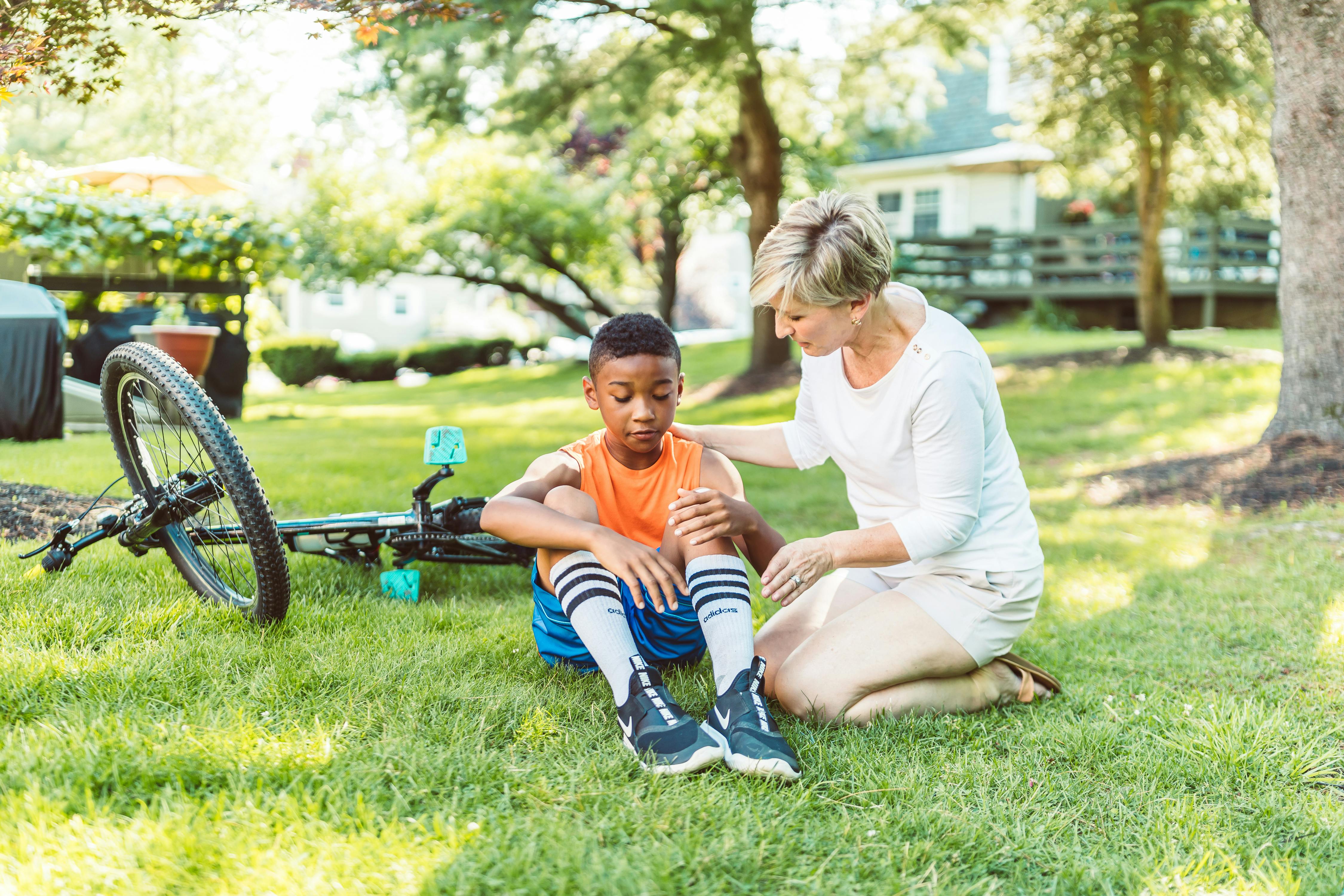 | Oh, you bumped your knee! That must have hurt. It’s okay, I’ve got you. Let’s sit for a moment. Let’s check it out — all okay? Next time we’ll go slower, okay? |
| Grazed/scraped knee | 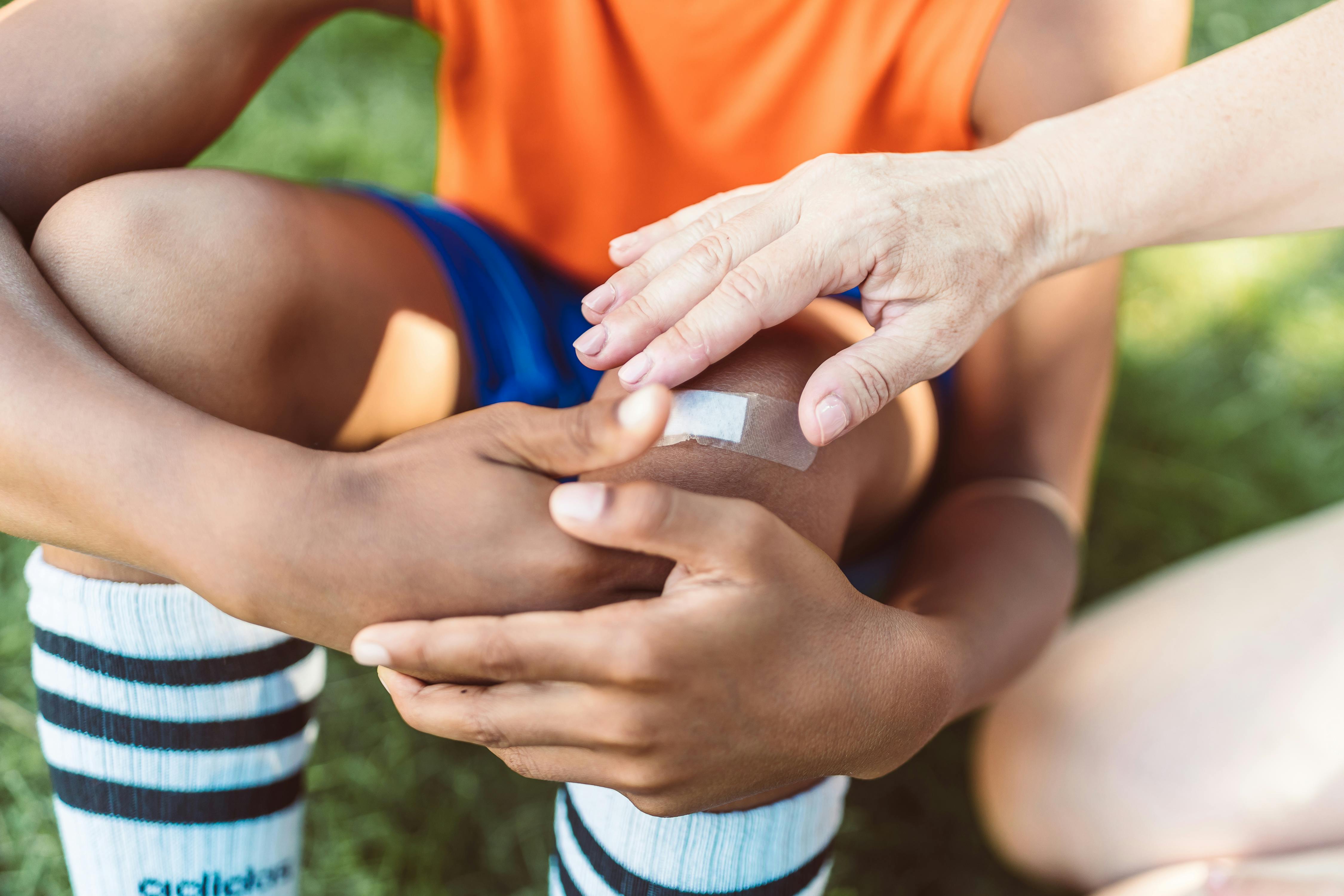 | Oh, you scraped your knee! That hurts, doesn’t it? It’s just a little scratch, all better soon. Let’s clean it up and put a bandage on. Be gentle next time — we’ll take care of it. |
| Stung by something |  | Oh no, that must itch! Let’s put some cream on it. It will feel better soon. Don’t scratch, let’s take care of it together. That stung, didn’t it? |
| Tripped over a small object |  | Oops! You tripped. Next time, watch your step. Next time, look out for the stick/rock. That was a little stumble — all okay! |
| Pinched by another child |  | Ouch! That pinched, didn’t it? Gentle hands, please. / Let’s use soft touches. (said to the pincher) |
Past Simple vs. Present Perfect
Grammar books often tell us to use the present perfect when a past action has a visible result in the present. For example: “You’ve been stung by something.” — I can see the sting mark on your skin, and it’s red.
So why do parents naturally say, “You fell,” instead of “You’ve fallen”?
In real-life speech, we often simply name what happened. When a child falls, a parent’s first instinct is to identify the event: “You fell.” “You tripped.”
We’re labeling the action that just occurred. It feels immediate and concrete. The focus is on the event itself, not on its present result.
The present perfect can sound slightly more analytical. Compare:
“You fell.” → natural, emotional, immediate.
“You’ve fallen.” → slightly more formal, more descriptive.
“You’ve fallen” isn’t wrong — it just sounds less like spontaneous parent speech and more like commentary.
In everyday spoken English, especially in emotional moments, people tend to prefer the simple past.
+ Just
When we add “just,” the present perfect starts to sound more natural. Compare:
“You just fell” and “You’ve just fallen.”
Both are grammatically correct. However, in American English, the simple past is very common even with “just,” so most parents would naturally say, “You just fell.” In British English, you’re more likely to hear the present perfect — “You’ve just fallen.” Even so, many British parents would still simply say, “You fell,” especially in the immediacy of the moment.
Grammar Takeaway
Emotional immediacy favors the simple past. In the moment, parents usually focus on naming what just happened: “You fell,” “You tripped,” “You bumped your head.”
However, a parent may naturally use the present perfect when the focus shifts from the event itself to its present result. For example:
“You’ve hurt your knee.” — here the emphasis is on the injury now, not on the act of falling.
Did you find this post useful? Would you like more content like this? Be sure to subscribe to this blog not to miss a thing.😉
 Enguroo Online English School