
What is spring like where you live? When does the weather turn warm and pleasant? Are there still chilly days mixed in? Does your spring resemble the one in the picture below? Take a close look and try to describe it. How detailed can you be? In this post, we’ll practice describing the scene—first at an intermediate level, then at an advanced level. Why? To expand your descriptive vocabulary and help you express beauty more eloquently. Read on and discover how to capture the essence of spring in words.
🎚️ Intermediate Level
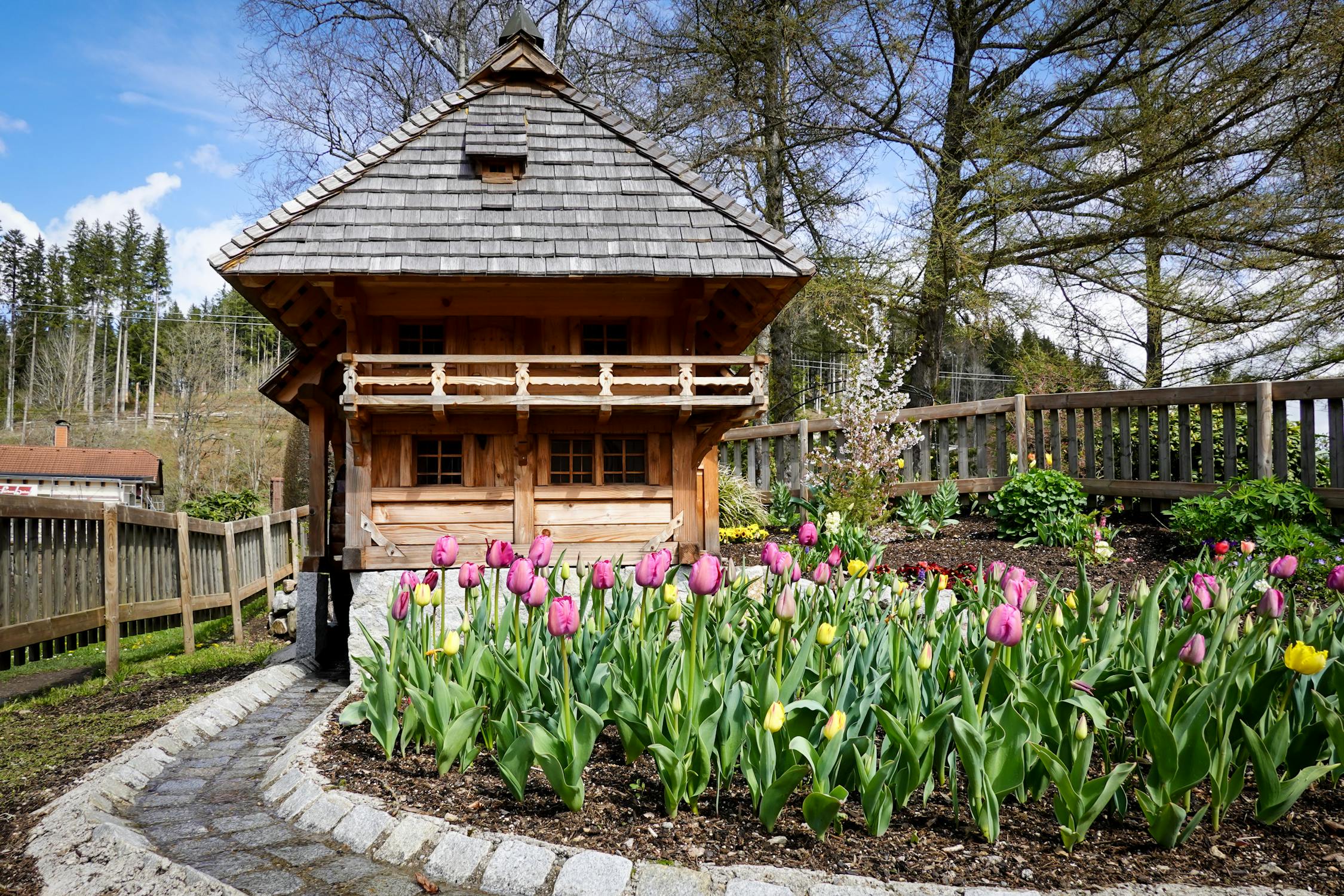
The spring scene in the picture is vibrant (1) and full of life. The tulips in the flower bed are in full bloom (4), showing classic signs of early to mid-spring. Their colors—shades of pink, purple, and yellow—stand out (2) brightly against the rich, dark soil, suggesting they’ve recently bloomed after the colder months. The green leaves are fresh and upright (3), indicating that the flowers are at their peak (4).
Behind the tulips, a small flowering tree is covered in* delicate white blossoms, a typical sight in spring as many trees awaken and begin to flower. Other plants and shrubs** in the background also show new growth, with healthy green leaves and some additional colorful blooms scattered throughout the garden bed.
The trees in the background are starting to bud (5) or have light green new leaves, showing that they are just beginning to leaf out (6) after winter. The sunlight is soft, and the sky has a mix of clouds and blue, giving the feeling of a crisp but pleasant spring day—warm enough for flowers to bloom, but still fresh and cool in the air.
- vibrant (of a color) – very bright
- in full bloom = at one’s peak (of flowers)
- to stand out – to be visibly distinct or clearly noticeable in contrast to the surrounding environment; = to contrast sharply, to catch the eye
- upright – standing straight up or growing vertically, rather than drooping or wilting
- to bud – to begin producing buds—small growths that will develop into leaves, flowers, or shoots
- to leaf out – to start growing new leaves, typically after a dormant season like winter
*Wondering whether to use “in” or “with” in phrases like “covered in/with“? Check out this post to find the answer.
**Shrub vs. Bush: The terms “shrub” and “bush” are often used interchangeably, but there are subtle differences in usage and connotation, depending on the context. “Shrub” is a more formal, botanical term, while “bush” is more casual. In terms of appearance, a shrub is typically trimmed, defined, and ornamental, whereas a bush tends to be denser and possibly wild or untamed.
🎚️ Advanced Level
The image captures a quintessential (1) springtime tableau (2), rich in color, texture, and seasonal vitality. At the forefront, a profusion (3) of tulips in varying shades of magenta (4), yellow, and soft pink punctuates (5) the garden bed with vibrant, upright blooms. Their lush green foliage is crisp and unblemished (6), reflecting the freshness of early to mid-spring, when plants emerge with renewed vigor after the dormancy of winter.
Behind this lively floral display stands a modest yet charming wooden cottage, constructed in a traditional alpine style with cedar shingles and ornately (7) carved balcony railings. Its warm, honey-toned timber harmonizes beautifully with the natural surroundings, further enhancing the rustic (8) and idyllic atmosphere.
A slender tree to the right of the cottage is adorned with delicate white blossoms, likely a flowering cherry or plum, which elegantly signals the season’s ephemeral (9) beauty. Surrounding it are carefully maintained beds of perennials (10) and leafy shrubs, many just beginning to unfurl (11) new growth. The landscaping is bordered by a low stone edge and a winding cobbled path that guides the eye gently through the composition, suggesting a thoughtful, curated (12) approach to garden design.
In the background, tall deciduous (13) trees—some just beginning to leaf out—frame the scene with soft, budding canopies (14), while a patch of evergreens provides contrast and depth. The sky above is a classic spring mix: partly cloudy with streaks of blue, allowing intermittent (15) sunlight to bathe the landscape in a soft, diffused glow. The overall impression is one of serene renewal, where nature, architecture, and human touch converge (16) in a quiet celebration of the season’s return.
- quintessential /ˌkwɪn.tɪˈsen.ʃəl/ (formal) – representing the purest, most perfect, or most typical example of something; = classic, definitive (common collocations: quintessential example, spring, charm, beauty)
- tableau /ˈtæb.loʊ/ (plural: tableaux /ˈtæb.loʊz/) – a striking or artistic scene (CCs: vivid, dramatic tableau)
- profusion – a large quantity or abundance of something, often used to describe something beautiful or rich like flowers, colors, or detail (CCs: a profusion of flowers, color, detail; in profusion = in large amounts)
- magenta /məˈdʒen.tə/ – a purplish-red color, bold and vivid (see the peony below) (CCs: magenta hue, shade, tone)
- to punctuate /ˈpʌŋk.tuː.eɪt/ – to interrupt or break up a surface or scene with repeated, striking elements (CCS: to punctuate the landscape, scene, skyline, to punctuate with blossoms)
- unblemished – free from marks, spots, damage, or imperfections (CCs: unblemished skin, reputation, surface)
- ornate /ɔːrˈneɪt/ – highly decorated, often with elaborate detail or complex patterns (CCs: ornate carvings, architecture, decoration, furniture)
- rustic /ˈrʌs.tɪk/ – having a simple, rural, or country-style appearance—often associated with natural materials and handcrafted charm (CCs: rustic charm, cabin, cottage, atmosphere, furniture, design, style, simplicity)
- ephemeral /ɪˈfem.ɚ.əl/ – lasting for a very short time (CCs: ephemeral beauty, moment, bloom, joy)
- perennial /pəˈren.i.əl/ – a plant that lives for multiple years, blooming annually. (vs. annuals, which last one season) (CCs: perennial flower, plant, herb; hardy, low-maintenance perennial)
- to unfurl – to unroll, unfold, or spread out something that was previously folded or closed (CCs: leaves, petals, a flag, sails)
- to curate /ˈkjʊr.ət/ – to select, organize, and present content, objects, or experiences in a thoughtful or intentional way (CCs: curated collection, space, playlist, garden, experience; carefully curated)
- deciduous /dɪˈsɪdʒ.u.əs/ – (of trees/plants) shedding leaves annually, usually in the fall; opposite: evergreen (CCs: deciduous tree, wood, species, plant)
- canopy /ˈkæn.ə.pi/ – the branches and leaves that spread out at the top of a group of trees forming a type of roof (CCs: forest, jungle canopy, leafy canopy, dense, thick, tree canopy)
- intermittent /ˌɪn.t̬ɚˈmɪt.ənt/ – starting and stopping at intervals; not continuous (CCs: intermittent rain, snow, showers, sunshine)
- to converge /kənˈvɝːdʒ/ – to come together at a point or into a unified whole (CCs: ideas, styles converge; path, roads, lines converge)

Practice
Exercise 1. Click the link here and match the words with their synonyms.
Exercise 2. Click the link here and fill in the blanks with the right words.
Did you enjoy this article? Want more like it? Subscribe to the blog so you don’t miss out on new, helpful posts shared every week!
 Enguroo Online English School