
What can be better than a cup of tea on a cool autumn day? Hardly anything, perhaps. So, allow us to invite you to a little tea party—right here in this post, to explore some delightful, tea-themed language that’s sure to warm your heart and tickle your taste buds. 🍵

Enjoying Tea Together
Sophie: Hey, want to come over for some tea? (1) I just got a new loose-leaf blend (2) I think you’ll love.
Maya: Ooh, that sounds perfect! I’d love to. What kind is it?
S: It’s an oolong (3) with hints (4) of peach and jasmine. Really aromatic. I’ve been letting it steep (5) for about three minutes—just long enough for a smooth infusion (6) without any bitterness.
M: That sounds amazing. I’m still trying to figure out the best steeping times for different teas. I always overdo green tea and end up with something that tastes like spinach water.
S: Haha, yeah, green tea is picky. Two minutes max in water around 80°C. Otherwise, it turns into bitter soup.
M: Noted (7). Wow, this smells incredible! The aroma is so floral and calming.
S: Right? That’s the jasmine. I like using a glass teapot so I can watch the leaves unfurl—it’s part of the whole experience.
M: You’re really becoming a tea connoisseur (8) (/ˌkɑː.nəˈsɝː/), huh?
S: Trying to be! I even got this little tea timer. Makes me feel like I know what I’m doing.
M: Well, this cup is absolutely perfect. It’s warming and just sweet enough. Makes me want to curl up with a book.
S: That’s the magic of tea. It’s not just a drink—it’s a ritual.
M: Cheers to that (9). Thanks for sharing this with me.
1. Functional Language: Invitation
In the dialog above, Sophie invites her friend Maya over to drink some tea with “Hey, want to come over for some tea?” (an informal/elliptical question, where part of the structure (“do you”) is left out because it’s understood from context). Here are several alternatives to “Want to come over for some tea?” ranging from casual to a bit more polite, all useful as functional language for inviting someone.
- Casual invitations: Feel like coming over for some tea? How about a cup of tea at my place? In the mood for some tea? Come by for tea if you’re free!
- Friendly but slightly more polite:
Would you like to come over for a cup of tea? I was just about to make some tea—want to join me? I’ve got the kettle on. Care to join me for a cuppa? How about dropping by for some tea and a chat? Would you be interested in coming over for some tea?
7. Functional Language: Acknowledgment
In the dialog, Maya responds to information that Sophie shares with “Noted.” It means “I’ve heard you, I understand, and I’ll remember that,” which serves as functional language, specifically in the category of acknowledging a point. In friendly, informal conversation, “Noted” can sound a little dry or clipped (sometimes even sarcastic), though it worked fine in the context above. But here area few alternatives for friendly chats:
- Got it—two minutes max for green tea.
- Oh okay, good to know. I’ve definitely been overdoing it.
- Makes sense. I didn’t realize temperature mattered that much.
- Thanks for the tip! I’ll try that next time.
- I’ll remember that—no more spinach water!
- Ah, that explains it. I’ve been using boiling water every time.
- Duly noted, tea master.
9. Functional Language: Expressing Shared Feeling or Approval
At the end of the dialog, Maya says “Cheers to that,” and it’s another example of functional language. It falls under the categories of agreement, celebration and approval. It’s like saying “I completely agree with that and I’m happy to toast it!” Here are some casual, friendly options that carry the same kind of vibe:
- I’ll drink to that!
- Couldn’t agree more.
- Absolutely.
- You said it!
- Here’s to that.
- Amen to that!
- Love that!
- Right? So true.
Other Vocabulary
- (2) “I just got a new loose-leaf blendI think you’ll love.” A blend is a mixture of different types of tea leaves, herbs, spices, flowers, or flavorings combined to create a specific taste and aroma. It’s kind of like a recipe. “Earl Grey” is a famous blend of black tea flavored with bergamot orange oil. Loose-leaf tea refers to whole or large pieces of dried tea leaves that are not packed in a teabag. You usually brew it using a teapot, infuser, or tea strainer (see the pictures below.)
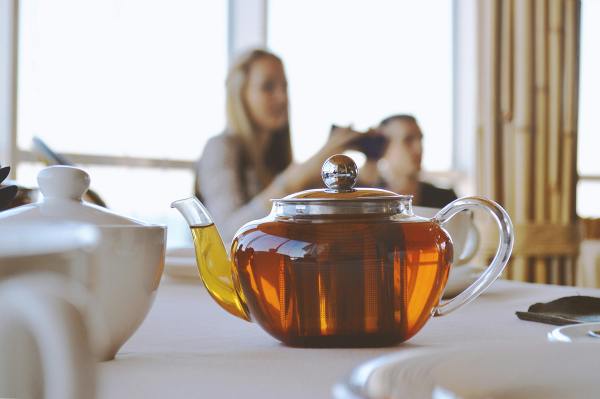
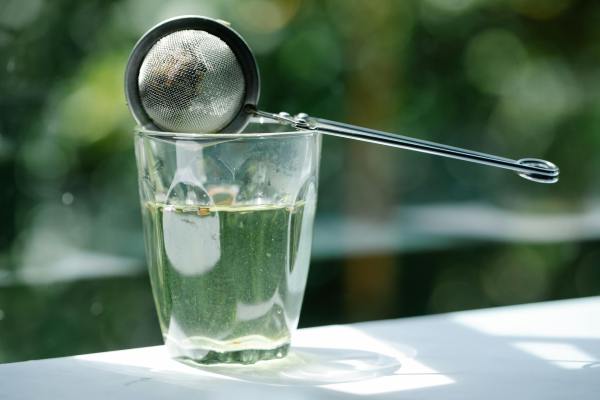
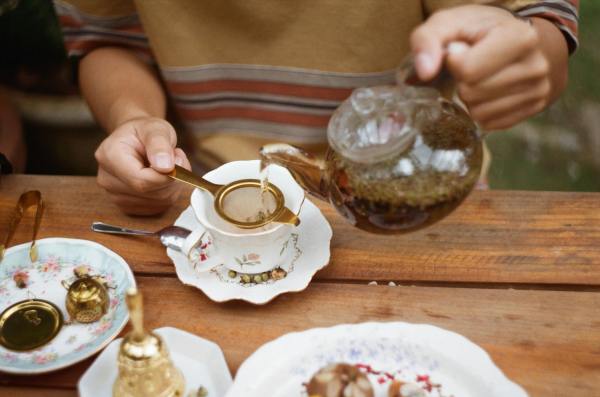
- (3) It’s an oolong with hints of peach and jasmine. Oolong is a type of tea that falls between green tea and black tea in terms of flavor and strength. Oolong teas can taste floral, fruity, toasty, or even creamy, depending on the variety and how it’s processed. Why is “an” used before “oolong,” you may be wondering. Here, “oolong” is being treated as a countable noun, meaning a kind or type of oolong tea.
- (4) It’s an oolong with hints of peach and jasmine. Here, “hint” means a small, subtle amount of a flavor or scent. Synonyms in this context: touch, note, trace.
- (5) I’ve been letting it steep for about three minutes. In the context of tea, “steep” means to soak the tea leaves or tea bag in hot water so that the flavor, aroma, and nutrients are drawn out into the water.
- (6) I’ve been letting it steep for about 3 minutes—just long enough for a smooth infusion without any bitterness. Infusion refers to the liquid that results from steeping the tea. It’s the tea you drink after the tea leaves or bag have been soaked (= steeped) in hot water.
- (8) You’re really becoming a tea connoisseur /ˌkɑː.nəˈsɝː/, huh? A tea connoisseur is someone who knows a lot about tea and enjoys it greatly.
We hope you enjoyed this tea-inspired post and that it’s put you in the mood for a nice cup of tea. If you’d like, leave a comment below to share your thoughts on the content, let us know what English topics you’d like help with, or feel free to ask any questions you have!
 Enguroo Online English School